‘Rebuilding Sri Lanka’ National Initiative Launched: Let us collaborate to restore the nation by uniting all our strengths – President
President Anura Kumara Dissanayake stated that, instead of an era in which rulers evaded responsibility by attributing failures to disasters and pandemics, the country will now rise again in the face of adversity and work to bequeath to the people a nation better than it was before.
Highlighting that the disaster will not serve as an excuse to reverse or hinder the government’s intended programmes aimed at steering the nation towards a sustainable development trajectory with transformation across all sectors, the President called upon everyone to unite in order to effectively promote the initiative to reconstruct the country by leveraging all available resources.
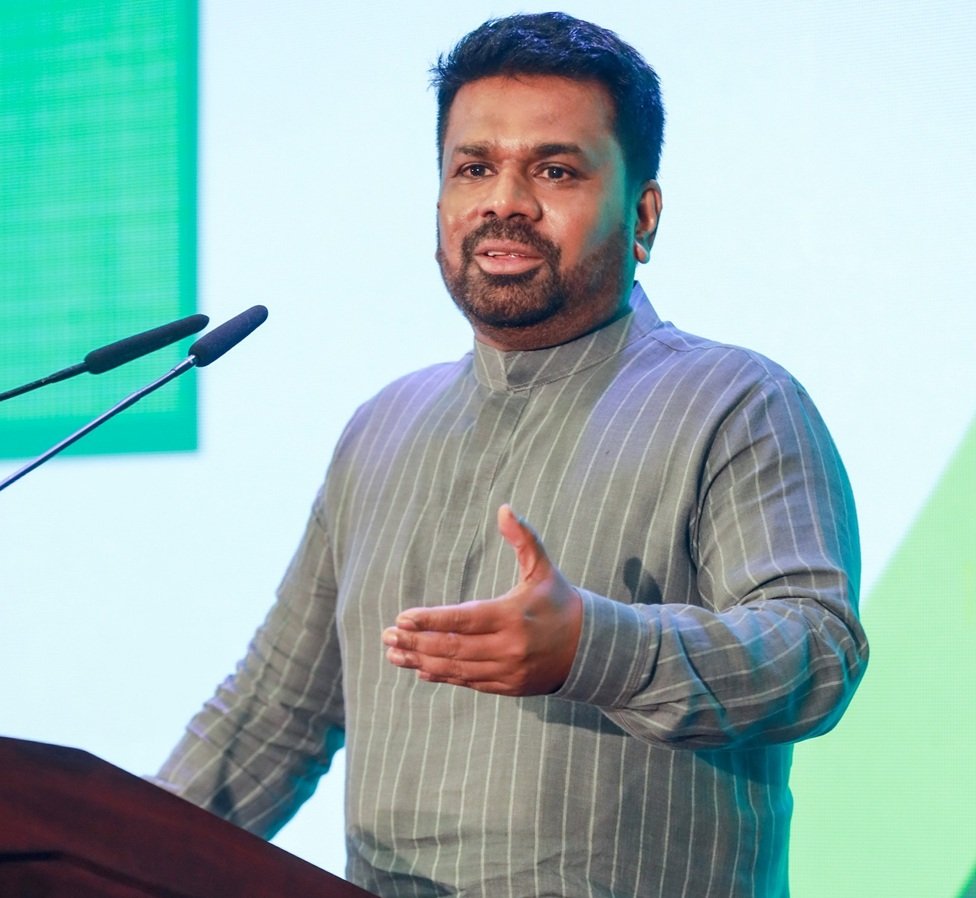
President Anura Kumara Dissanayake made these remarks while addressing the inaugural ceremony of the ‘Rebuilding Sri Lanka’ National Programme held this morning (13) at the Lotus Hall of the Bandaranaike Memorial International Conference Hall (BMICH) in Colombo.
The ‘Rebuilding Sri Lanka’ programme has been launched in response to the urgent need for a highly coordinated national recovery mechanism to address post-disaster rehabilitation and reconstruction efforts following the devastation caused by Cyclone Ditwah, which affected all regions of Sri Lanka, resulting in loss of life as well as damage to private and public property.
The launch of the website www.rebuildingsriLanka.gov.lk, which includes financial donations and other donations and related information for the ‘Rebuilding Sri Lanka’ programme, was also held at this event.
This website serves as a platform designed to unite individuals, resources and ideas aimed at reconstructing Sri Lanka through inclusive, transparent and sustainable initiatives, all with the vision of a revitalized Sri Lanka that is rebuilt in a robust, equitable and sustainable way.
Donations can be made through this website and all information about those donations will be displayed on this website. This is an effort to ensure trust and accountability. It provides the opportunity to make donations in the form of financial assistance, material assistance, land, etc., as well as for specific projects and specific and factual information about the extent and nature of the damage caused by the disaster is provided here by district.
On this occasion, details of land donated by several individuals were also uploaded to the website.
President Dissanayake further noted that while natural disasters do not discriminate, due to the prevailing inequalities in the country, more than 80% of those affected by this disaster are economically disadvantaged people. The President emphasised that the decision to provide compensation marking the highest compensation in the country’s history was taken with the intention of improving their living conditions, even if only by a single step.
The President also pointed out that many nations across the world have been built not by merely drifting along, but by confronting shocks, enduring them and rebuilding in their aftermath.
Reiterating his commitment to accountability, the President affirmed that responsibility would be borne for every rupee received for the rebuilding effort, while ensuring fiscal discipline and transparency. He stated that he places trust not only in himself, but also in the state machinery, experts and technologists, as well as in the distinctive intrinsic values of the Sri Lankan people.
President Anura Kumara Dissanayake further expressing his views stated;
Towards the end of last year, we as a nation had to face a major disaster. At the time of facing this calamity and even prior to that, following the economic crisis the country had to face, we all know that we were recovering step by step. As we all know, every citizen of our country was affected by the great tragedy of the economic collapse that occurred a few years ago. All communities, in their respective spheres, became victims of that disaster. Therefore, the people harboured a hope and a firm determination to restore the country and to ensure that it would not once again fall into such a calamity. In order to build that future, the people placed their trust in us and made the courageous decision to bring us to power.
After assuming office, while planning for the future and achieving notable successes in several sectors, we were confronted with this disaster. In many respects, the year 2025 marked a series of turning points. At the very moment when we were stepping into a transformative era by strengthening the rule of law, enhancing the efficiency of the public service, changing political culture, undertaking economic and educational reforms, we were struck by this disaster.
Many expected that this calamity would derail the agenda we had prepared. That agenda is a sustainable project to build the country’s future. We therefore resolved with firm determination that, regardless of the disaster we faced, we would not abandon our agenda. We could easily have absolved ourselves of responsibility by blaming the disaster for every act of destruction, crime and collapse. That is what has happened in the past: for thirty years every form of devastation was attributed to the war.
Disasters were also concealed under the guise of epidemics. We had no need to use this disaster as an excuse to reverse or paralyse the programme we had prepared. Our intention was to continue moving forward within the framework of our agenda.
At the time we faced this disaster, Parliament was in the process of preparing our Budget. Some suggested that we suspend it and present an interim Budget, while others proposed completely revising the Budget to suit the disaster. We did not do so, because that Budget was a visionary document intended to take our country, our economy and the lives of our people forward. Our struggle was to determine how to confront this disaster without shrinking our agenda. Accordingly, the Budget we passed in Parliament on 5 December was the very same Budget prepared before the cyclone struck. This is an extremely important point.
The next challenge we faced was how to allocate additional funds without damaging the strategies laid out in the Budget. We are bound by the mandate given to us by the people. Therefore, without surrendering that mandate to any organisation or pressure group, we have presented a supplementary estimate of Rs. 500 billion solely for this purpose. Where necessary, Budget proposals can also be implemented on a priority basis.
Thus, our effort to face this challenge without reversing our programme is of vital importance. At the outset of the disaster, our foremost task was to rescue the people. Approximately 700,000 families, comprising about 2.4 million individuals, were affected in one way or another. Around 6,000 houses were completely destroyed and about 110,000 suffered partial damage.
In addition, around 10,000 houses that were not damaged have been identified as uninhabitable because of high-risk conditions in those areas and this identification process is continuing. Altogether, more than 20,000 new houses must be constructed.
The 2026 Budget had already planned for the construction of 31,000 new houses. Although the war ended in 2009, a large number of people who lost their homes continue to live in camps and temporary shelters in the North. Rs. 5,000 million had been allocated to build 2,500 houses for them and we did not alter this. Furthermore, a participatory housing programme for economically distressed families had been launched, with plans to build 10,000 houses this year and an allocation of Rs. 10,000 million. Taken together, over 50,000 houses will need to be built in 2026. With World Bank assistance, we have also prepared a preliminary estimate amounting to USD 4.1 billion. The value of the projects we have already prepared is around USD 2.8 billion and further projects are yet to be identified.
No society is transformed merely by going with the flow smoothly. It is the shocks a society and a country experience that shape states. Nations advance and the nations of the world have been built through shocks, resilience and rebuilding thereafter.
In the face of this disaster, we have two paths before us. We can remain paralysed by shock crying over what has happened and lamenting about the losses and lamenting about all the obstacles we have to face, or we can rise again with courage and confidence. As a Government, we have chosen the second path. We strive to rise from this shock in order to build a country better than it was before.
There is a common saying that natural disasters do not discriminate, yet the inequalities in our society mean that their impact is far from equal. More than 80 per cent of those affected are people already oppressed by social inequality, those living in high-risk zones, in houses that cannot withstand strong winds or even minor floods.
Our responsibility, therefore, is not to restore these communities merely to their former condition, but to take them further. Our objective is not to return them to their previous standard of living, but to provide a better one. Accordingly, we will grant Rs. 5 million for each newly constructed house. Some ask whether a house is really worth that much, but we believe these people deserve a home better than the one they lost.
For partially damaged houses, we will provide Rs. 500,000 without requiring an assessment. Our aim is to enable families to extend and improve their existing homes so that they become better than before. Those affected by complete and partial destruction belong largely to the lowest strata of our economy and they must be given an opportunity. We must also provide concessions to help them restart agriculture, animal husbandry and industries.
Our first objective was to rescue the people, ensuring minimal loss of life. The second step was to accommodate them in safe centres and provide them facilities. The third step was to enable them to leave those centres, which we supported through financial assistance. Thereafter, we restored essential infrastructure such as electricity, communications, water and roads, completing most of this work within about two weeks. We acted swiftly to meet their basic needs, even temporarily, and subsequently supported the resumption of their livelihoods. Much of this work is now complete. Our next step is to convert these temporary structures into permanent ones.
We all know that the Central Highlands are the heart of our country. They played a significant role in our great civilisation and were once covered in dense forests. Our ancestors carefully conserved them and harnessed the rivers that flow from them for cultivation, building structures such as the Angammedilla and Minipe dams. Yet, through various distortions, we turned the plains into forests and cleared the highlands. The consequences of that are what we are facing today.
The Central Highlands are our heart, and 103 rivers originate from there. All of them are now close to becoming victims of this disaster. We must therefore adopt a long-term plan. This is a calamity centuries in the making and restoring the Highlands will take decades. We must breathe life back into this degraded and desiccated region. Reviving the Central Highlands is essential for future generations. We have prepared plans to that effect and are firmly committed to ensuring that no further damage is done, while implementing the necessary restoration measures.
Our experience during this disaster has shown that financial discipline must be safeguarded with utmost firmness. In times of crisis, normal procedures collapse and chaos creates avenues for
financial indiscipline. We therefore assume responsibility for every rupee you contribute, ensuring full financial discipline and complete transparency.
Public participation and trust are essential to this rebuilding process. I place my trust in myself, in our state machinery, particularly our technologists and experts and in the unique compassion of our people, who respond sensitively to the suffering of others.
Among those present on this occasion were Minister of Industry and Entrepreneurship Development Sunil Handunnetti; Minister of Health and Mass Media Dr Nalinda Jayatissa; Minister of Labour and Deputy Minister of Finance and Planning Dr Anil Jayantha Fernando; Minister of Energy Kumara Jayakody; other Ministers, Deputy Ministers and Members of Parliament; Secretary to the President Dr Nandika Sanath Kumanayake; Ministry Secretaries and state officials; foreign Ambassadors; representatives of international organisations providing financial assistance, including the United Nations; scholars, artists, private sector representatives and members of the security forces.