Challenges and Potentials for the Advancement of Digital Agricultural Extension Services in the Domestic Food Crop Sector: Evidence from Kurunegala District
- Editor
- March 15, 2026
- News, Technology
- Technology
- 0 Comments
Background
At present, agricultural extension services in the domestic food crop sector face numerous challenges that hinder the realization of their intended benefits. Consequently, digital agricultural extension services have emerged in recent years as an innovation that can transform extension into a more efficient and effective service, capable of addressing farmers’ needs with lower operational costs to the government. A variety of digital agricultural extension tools have been developed within the research and extension system. However, difficulties associated with their use, coupled with barriers experienced by both farmers and extension officers, have prevented these tools from achieving effective success. This study aims to identify the obstacles faced by farmers and officials in implementing digital agricultural extension services in the domestic food crop sector, to explore the potentials available to overcome such challenges, and to propose practical solutions and strategies that can be adopted.
Methodology
This study, conducted in 2024, was based in the Kurunegala District and covered five Agrarian Service Centers (Maho, Nikaweratiya, Nagollagama, Kobeigane, and Rambe). Data were collected from agricultural extension officers attached to these centres and 128 farmers belonging to 10 farmer organizations engaged in cultivating various crops. Information was obtained regarding farmers’ awareness of digital agricultural extension services, access to technology, and barriers to utilization. Data collection methods included face-to-face interviews, telephone discussions, focus group discussions, and short questionnaires. Both quantitative and qualitative analytical techniques were employed in processing the data.
Findings
The study provides evidence that, similar to other sectors in Sri Lanka, progress has been made in the use of digital tools and their benefits within the agricultural extension system of the food crop sector.
- Mobile phone usage is widespread among farmers, while digital tools and platforms developed by state, non-state, and private actors are also becoming increasingly integrated into farming communities. The National Agriculture Information and Communication Centre (NAICC) of the Department of Agriculture plays significant role in this regard.
- Within the district, 74% of farmers and all extension officers reported ownership of smart mobile phones. Among the farmers, 65% indicated that they use at least one digital agricultural extension tool to access agricultural knowledge and information.
- Social media platforms such as YouTube, WhatsApp groups, Facebook pages, and web-based radio (including the “Agri Radio” application) were the most commonly and regularly used tools.
- Extension officers also reported daily use of social media platforms to deliver extension services. However, both farmers and officers require further improvement in their ability to effectively use mobile applications for agricultural purposes.
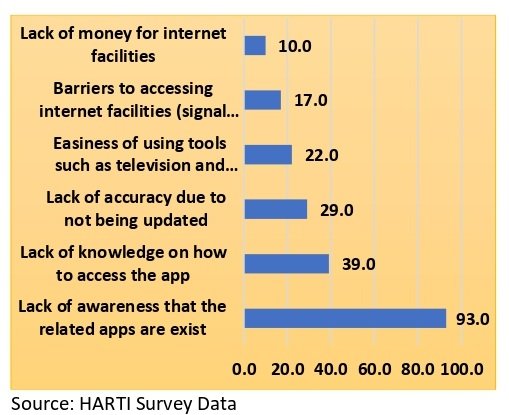
Source: HARTI Survey Data – Figure 1: Challenges in the use of digital agricultural extension tools
Issues face by the Farmers and Officers
- The main issues faced by farmers and officials regarding the use of digital agricultural extension tools, such as Lack of adequate awareness among farmers of existing digital agricultural applications and tools designed to meet extension needs, primarily due to limitations in internet access, affordability, and disparities in digital literacy (93%), Problems of accuracy and reliability caused by outdated mobile applications and non-updated information (29%).
Recommendations
To minimize the challenges and weaknesses encountered by farmers and officials in using digital agricultural extension services in Kurunegala District, and to capitalize on existing strengths and opportunities, the following strategies are proposed:
- Enhancing Digital Literacy of Field-Level Agricultural Officers – Technical training should be provided to Agricultural Instructors, Technical Assistants, and Agricultural Research and Production Assistants to strengthen their digital skills
- Application of Digital Tools for Productivity and Climate Resilience – The use of mobile-based disease diagnostics, precision irrigation systems, and real-time soil analysis can enhance efficiency, increase resilience to climate shocks, and reduce crop damage through timely interventions,
- Capacity-Building Programs – Training and awareness programs should be conducted to familiarize farmers with the practical use of digital tools
- Youth Participation – There is a high level of interest in digital technology among rural youth, highlighting the need to integrate digital tools into school-level agricultural curricula. It is also essential to incorporate the specific agricultural needs and characteristics of youth groups when designing digital extension tools.
- Furthermore, creating an enabling environment that facilitates equitable access to agricultural knowledge and information is crucial. This can be achieved by strengthening and expanding existing digital agricultural extension services currently implemented through public–private partnerships, thereby ensuring that farmers receive information effectively and without disparities
- Public Awareness – Wider dissemination of information on digital agriculture through mass media should be promoted
- Regulation and Oversight – Dissemination of agricultural information through social media platforms should be regulated by state intervention
- Regional Call Centres – The feasibility of establishing agricultural advisory call centres in the Northern and Eastern Provinces should be examined
- Application Updating – Regular updates of mobile applications should be ensured.
Research Team:
M.D. Susila Lurdu, Sangeeth Prasad Fernando and Sagarika Hitihamu
Hector Kobbekaduwa Agrarian Research and Training Institute